SVC 07 / ROAD FORCE
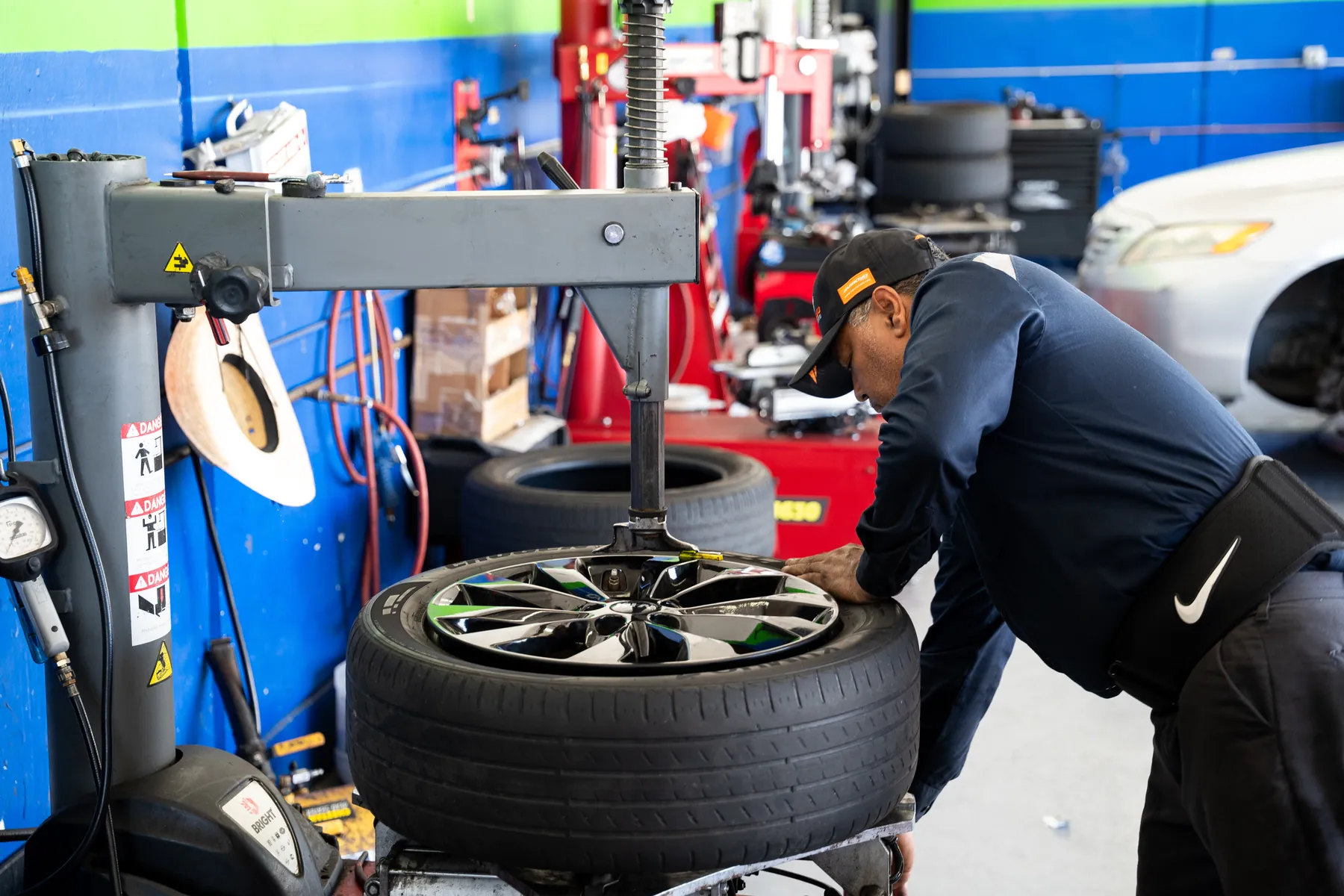
Road force balancing in Montclair
Balanced twice and it still shakes? A standard balancer only checks weight. Road force balancing checks how the tire behaves under load, which is where the stubborn vibrations come from.
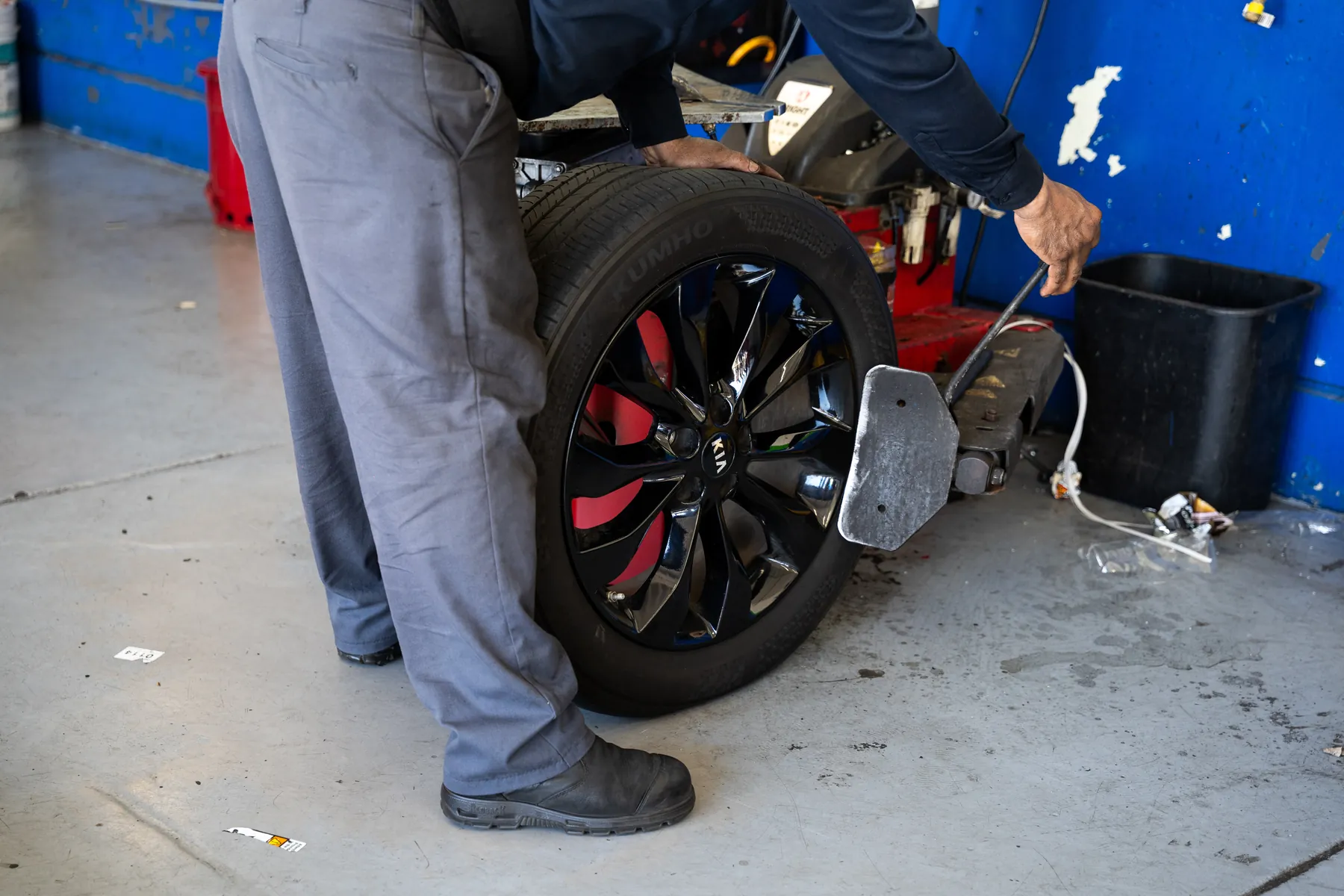
About road force balancing
A regular balancer spins the wheel in the air. That finds heavy spots, but a tire can be perfectly balanced and still not be perfectly round under the weight of the car. One section of the tire can be stiffer than the rest, or the wheel can have a slight high spot. You feel it as a vibration that weights can't fix.
A road force balancer presses a roller against the spinning tire to simulate the car's weight on the road. It measures how much the force changes as the tire turns. That number is road force variation.
When the variation is high, the fix is often match mounting: rotating the tire on the wheel so the tire's stiff spot lines up with the wheel's low spot. The two cancel out. If a tire is beyond what matching can correct, the machine shows it, and you've got the evidence to take a warranty question back to the seller.
Road force balancing makes sense for
- A vibration that's still there after a standard balance
- Low-profile tires and large-diameter wheels
- Vehicles known for being sensitive to vibration
- A steering wheel shimmy at a specific speed range
- A new set of tires that doesn't ride as smoothly as it should
What happens in the bay
Measure under load
The roller loads each tire and the machine reads radial force variation and runout on the wheel.
Match mount if needed
If the tire and wheel are fighting each other, the tire is rotated on the wheel to cancel the high and low spots.
Balance
Weights go on after the assembly is matched, so you're balancing the best possible combination.
Place the best assemblies up front
When readings vary across the set, the smoothest assemblies go on the front axle, where you feel vibration through the steering.
When road force finds what a spin balance misses
| Comparison | Standard spin balance | Road force balance |
|---|---|---|
| What it measures | Where the weight is, with the wheel spinning in the air. | Weight, plus how stiff and how round the tire is with a load pressing on it. |
| What it finds | Heavy spots. | Heavy spots, a stiff section of tire, a slightly out-of-round wheel, and a tire mounted at the wrong angle on the wheel. |
| How it fixes it | Counterweights on the rim. | Match mounting first, so the tire's stiff spot sits on the wheel's low spot, then counterweights. |
| When it's the right call | Every new mount and most vibrations. | A shake that survived a standard balance, low-profile tires, big wheels, and cars known to be picky. |
| When it can't help | A tire that's stiff or out of round. The weights will be right and the shake stays. | A tire whose variation is beyond what matching can cancel. The reading tells you, and that's your case for a replacement. |
Book road force balancing in Montclair.
Book online in a minute, or call (909) 321-2191. 5483 Moreno Street, Montclair.
Road force balancing questions
What's the difference between balancing and road force balancing?
Standard balancing corrects weight. Road force balancing also measures stiffness and roundness under load, and fixes them with match mounting where possible.
Do I need road force balancing on every set of tires?
No. Most vehicles are fine with a standard balance. It's the right tool for persistent vibrations, low-profile tires and sensitive vehicles.
Can road force balancing find a bad tire?
Yes. If a tire's force variation is too high to correct, the reading shows it. That's useful when you're asking for a warranty replacement.