
GUIDE / Service explained
Alignment vs. balancing: what each one fixes
Kwik Tire, Montclair · Updated · 5 min read
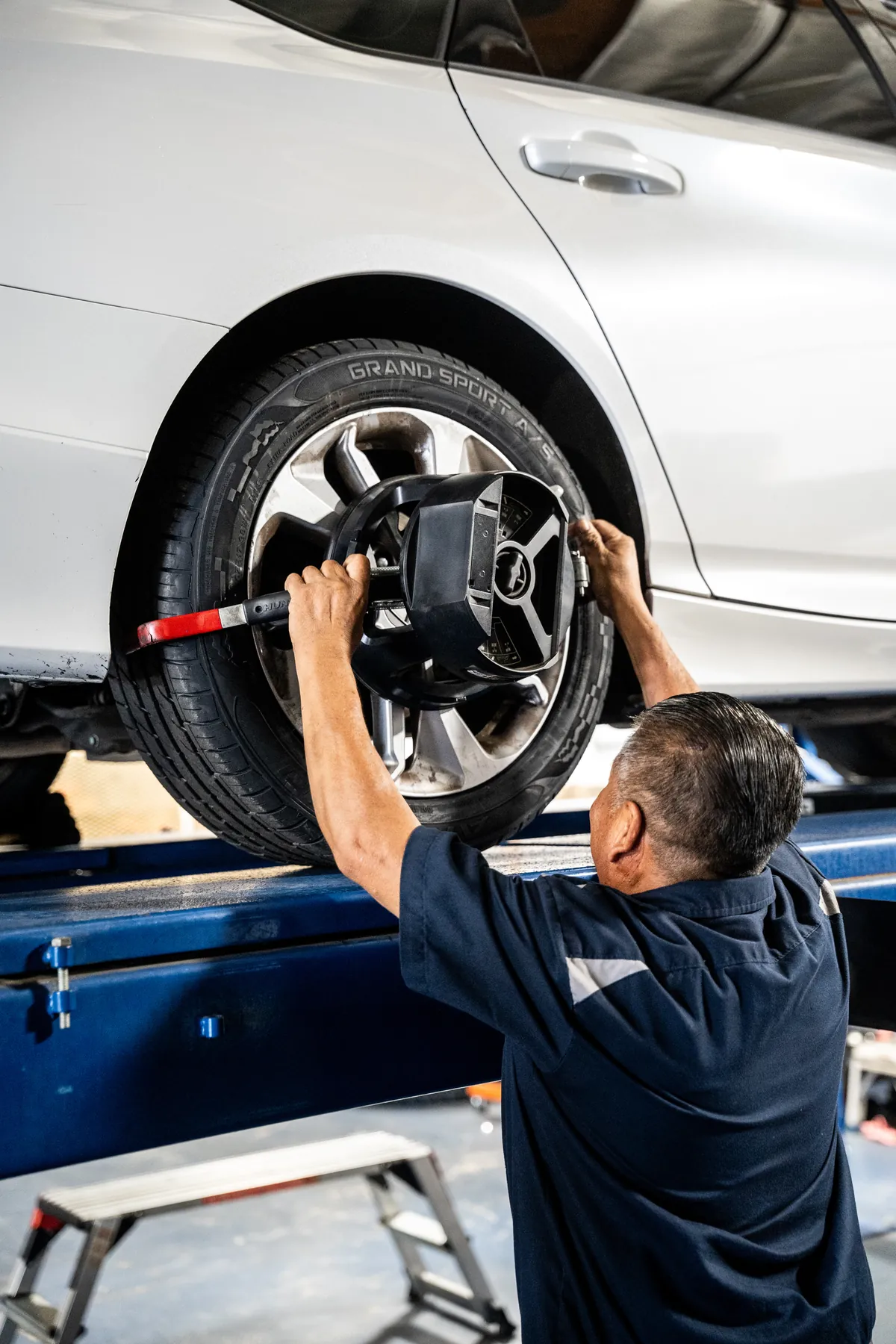
An alignment corrects the angles of the wheels, so it fixes pulling, an off-center steering wheel and edge wear. Balancing corrects uneven weight in the tire and wheel, so it fixes vibration at highway speed.
People mix these two up all the time, and it's easy to see why. Both happen around the wheels, both get recommended with new tires, and both affect how long tires last. But they solve different problems. Pay for the wrong one and the symptom is still there when you drive away.
The short version: alignment is about direction. Balance is about vibration.
| What you notice | Most likely cause | Service |
|---|---|---|
| Car drifts or pulls to one side | Alignment, a tire problem or uneven pressure | Pressure and tire check, then alignment |
| Steering wheel crooked when going straight | Alignment (toe) | Alignment |
| Inside or outside edge wearing fast | Alignment (camber or toe) | Alignment |
| Shake in the wheel or seat at highway speed | Balance | Balancing |
| Shake still there after balancing | Stiff spot in the tire or an out-of-round wheel | Road force balancing |
| Scalloped, patchy wear | Balance or worn suspension | Balancing plus an inspection |
What an alignment does
Alignment is the geometry of how each wheel sits on the car. A technician measures three angles and adjusts them back to the vehicle maker's spec:
- Toe: whether the fronts of the tires point slightly in or out, seen from above.
- Camber: whether the tops of the tires tilt in or out, seen from the front.
- Caster: the forward or backward tilt of the steering axis, seen from the side. It affects straight-line stability and how the wheel returns to center after a turn.
When those angles drift, the tires get scrubbed slightly sideways as they roll. The tire industry describes misaligned tires as experiencing stress as if the car were constantly cornering. You feel it as a pull or a steering wheel that sits off-center. You see it as one edge of the tread disappearing early, or a sawtooth feel across the tread called feathering.
Front-wheel-drive cars and anything with independent rear suspension need attention at all four wheels, not just the front. A four-wheel alignment also catches dog tracking, where the rear tires don't follow the path of the fronts.
What knocks an alignment out
Potholes. Curbs. Speed bumps taken too fast. Plain wear in the steering and suspension. Lowering or lifting a vehicle changes the geometry too. Worn parts like tie rod ends and ball joints let a wheel move in ways it shouldn't, and an alignment won't hold on a loose front end. If we see that before an alignment, we'll tell you first. We don't replace suspension parts, so that work goes to a repair shop before the alignment.
What balancing does
No tire and wheel weighs exactly the same all the way around. A heavier spot on one side, even a small one, turns into a repeated tug once it's spinning at freeway speed. You feel it through the steering wheel if it's a front tire, or through the seat and floor if it's a rear.
A balancing machine spins the tire and wheel, finds the heavy spot, and shows the technician where to place small counterweights on the wheel to cancel it. Tires should be balanced any time they're mounted on a wheel. That means new tires, a flat repair where the tire comes off, or moving tires onto different wheels.
An out-of-balance assembly doesn't just shake. It makes irregular contact with the road, which wears the tread unevenly, and the effect can be worse at specific speeds. Goodyear also points to extra wear on suspension parts.
Signs a balance is off
- A vibration that starts at a certain speed and may smooth out above it
- A missing wheel weight (look for a clean rectangle or a clip mark on the rim)
- The shake started right after tire work or a flat repair
- Cupped, patchy wear on the tread
Road force balancing, the third tool
Sometimes a car gets balanced, then balanced again, and still shakes. Weight isn't the problem. The tire may have a stiff spot in its construction, or the wheel may not be perfectly round. Neither one shows up on a machine that spins the wheel in the air.
A road force balancer presses a roller against the spinning tire to simulate the weight of the car, and measures how much the force changes as the tire turns. If the tire's stiff spot lines up with the wheel's high spot, they add together. Rotating the tire on the wheel so they cancel out, called match mounting, often fixes a vibration that weights couldn't. When a tire is beyond what matching can correct, the reading shows it.
It's the right tool for stubborn vibrations, low-profile tires on large wheels, and vehicles known for being sensitive to vibration. Details are on our road force balancing page.
When you need both
New tires are the obvious case. They get balanced as part of mounting, and an alignment protects them, because a set that goes on a misaligned car starts wearing wrong from the first mile. A hard pothole hit is another. It can bend a wheel (vibration) and knock the toe out (pull and wear) at the same time.
And some pulls aren't alignment at all. A tire with an internal defect can pull a car, which is why swapping the front tires side to side is a standard test. If the pull changes direction, it's the tire. Uneven pressures cause pulls too. So can a brake that drags. That's a brake shop's job, not ours, but we'll mention it if it looks that way.
Not sure which one your car needs? Book a tire inspection and tell us what you're feeling and at what speed. We'll check pressures, tread and wheels first, then recommend an alignment, a balance or road force work based on what we find. To read the wear on your own tires first, see our guide to uneven tire wear.
Want a second set of eyes? Book wheel alignment.
Book online in a minute, or call (909) 321-2191. 5483 Moreno Street, Montclair.
More questions
Does balancing fix a car that pulls?
No. A pull comes from alignment, a tire problem or uneven pressure, and balancing only corrects weight distribution. Start with pressures and an alignment check.
Do I need an alignment after buying new tires?
It's strongly recommended, because new tires wear according to whatever angles the car has now. If the check shows everything in spec, no adjustment is needed.
How often should wheels be balanced?
Every time a tire is mounted on a wheel, and any time a new vibration shows up. A lost wheel weight is enough to bring the shake back.
Can a bent wheel cause vibration even after balancing?
Yes. A wheel that isn't round can't be fixed with weights, and road force balancing will show the runout. We don't repair wheels, but match mounting can reduce the effect, or we can help you find a replacement wheel.
Keep reading
5 MIN / Service explained
What the TPMS light means and what to do
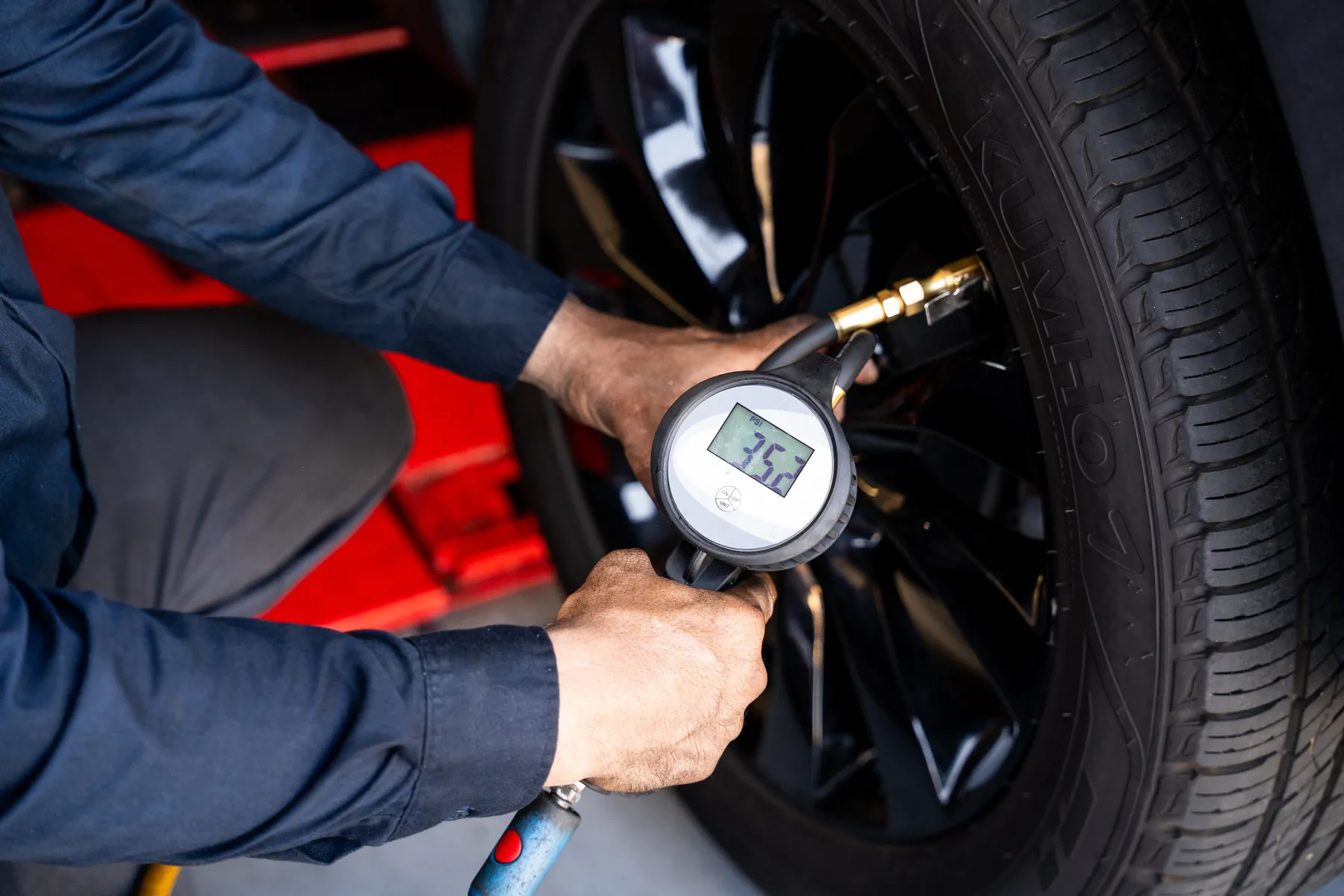
A solid TPMS light means a tire is low. Flashing then solid means a system fault. What triggers each, why cold mornings set it off, and what to do.
5 MIN / Service explained
Which flat tires can be repaired
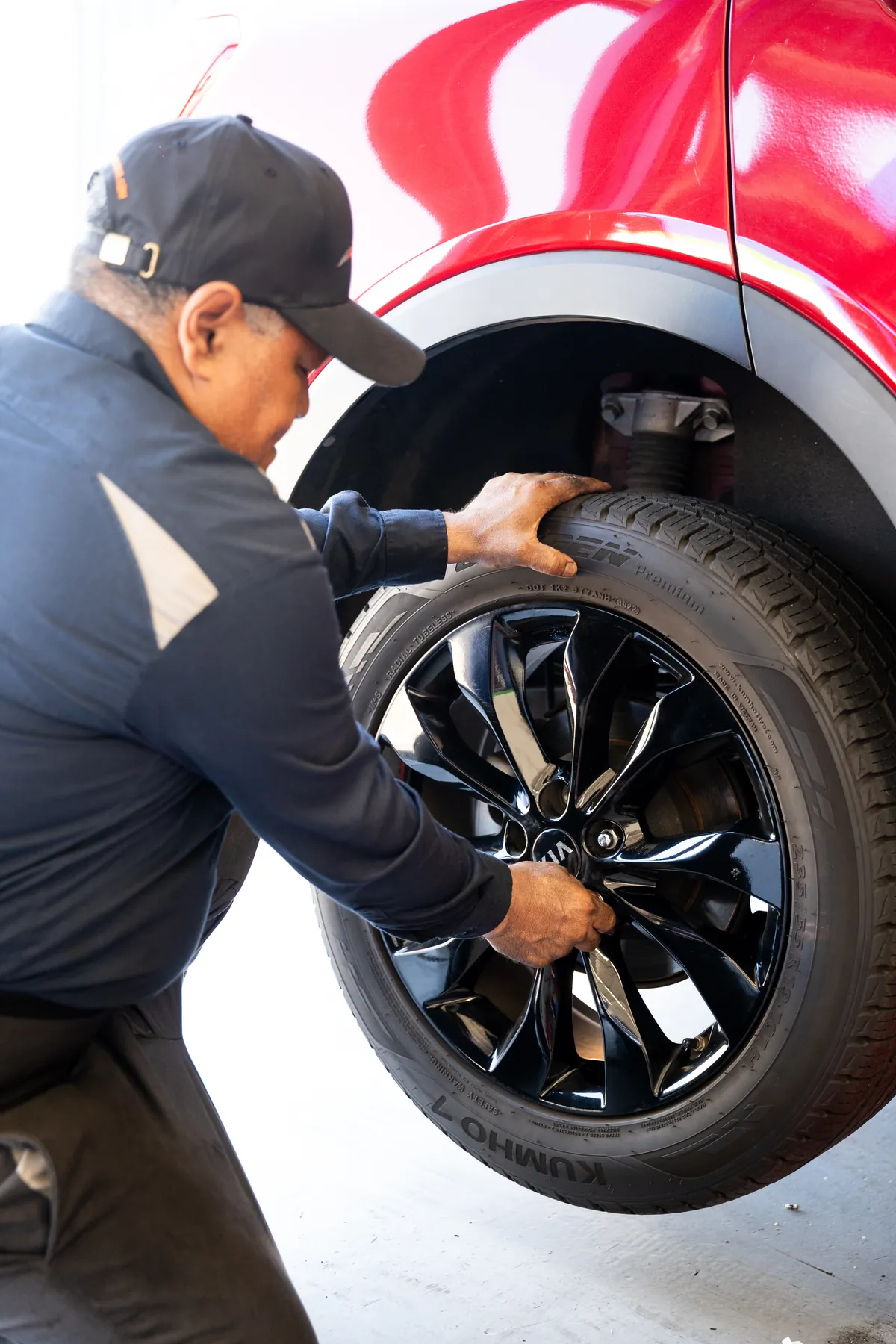
The tire industry's repair rules in plain English: tread area only, 1/4 inch maximum, plug and patch from the inside, and why the sidewall can't be fixed.
6 MIN / Buying tires
How to read a tire size
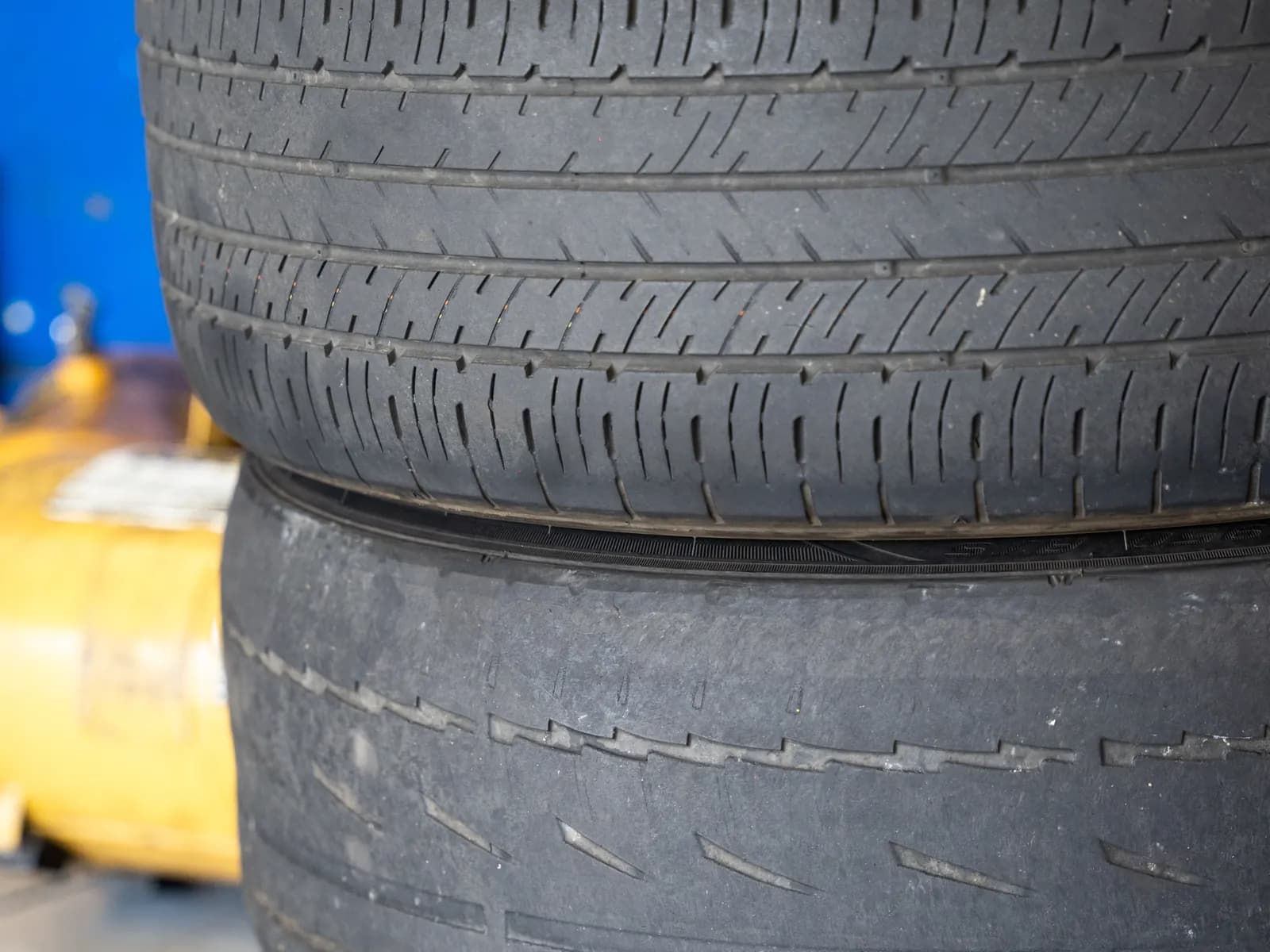
What every part of a tire size like 225/65R17 102H means: width, aspect ratio, wheel size, load index, speed rating and the DOT date code.