
GUIDE / Tire care
Uneven tire wear: what the pattern tells you
Kwik Tire, Montclair · Updated · 5 min read
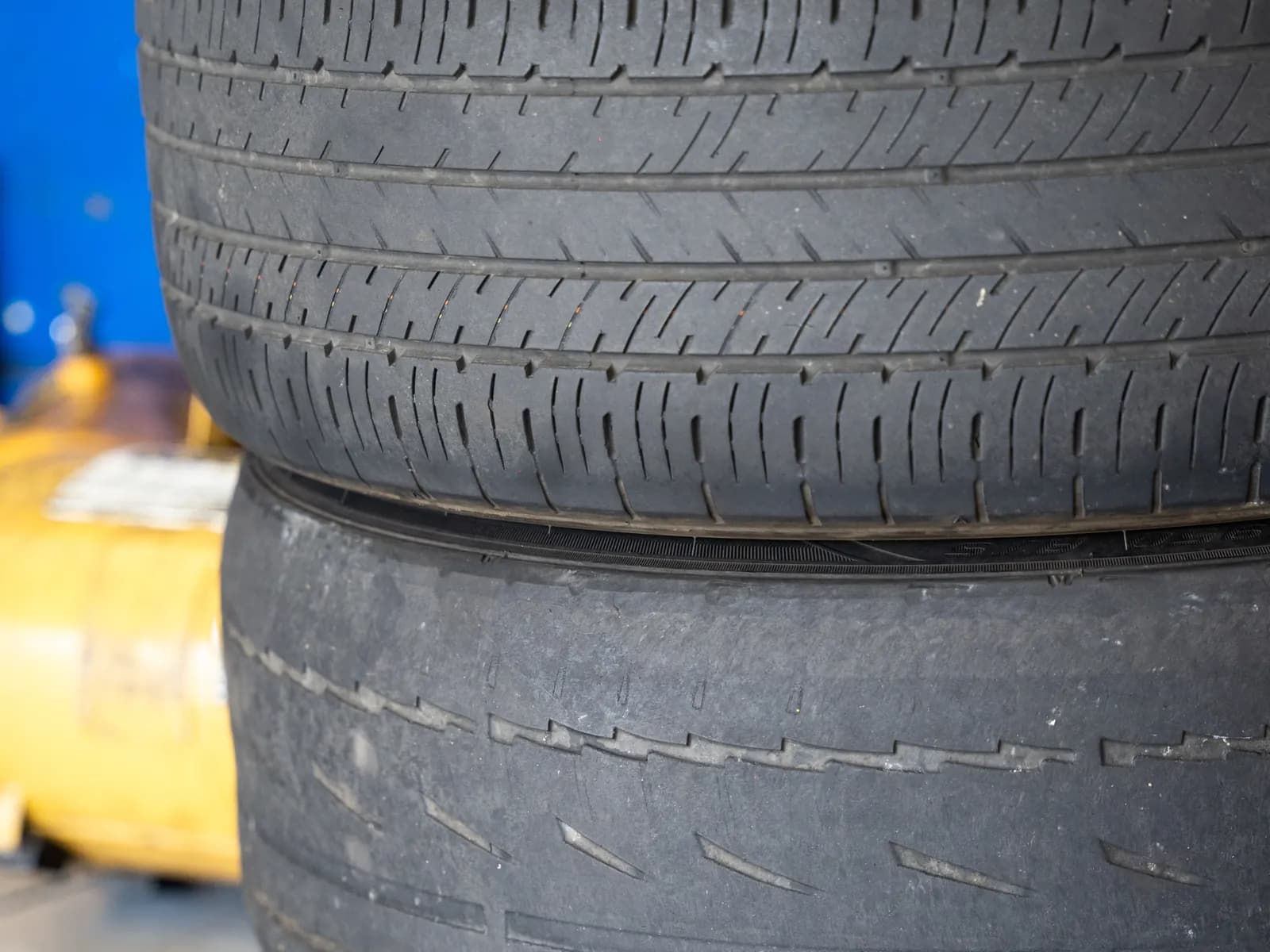
Center wear usually means too much air, both edges worn means too little, one edge worn points to camber, feathered tread points to toe, and cupping points to worn suspension or a balance problem. Fix the cause before you replace the tires, or the new set will wear the same way.
A worn tire is a record of how the car has been treating it. Look across the tread from edge to edge and run a hand over it, and the pattern usually tells you what went wrong. Here's how to read it, and what to do about each one.
How to look at your tires
Turn the steering wheel all the way to one side so you can see the full width of the front tires. Look across the tread from the inside edge to the outside edge. Then run your palm across it gently, in both directions. Some patterns you see. Others, like feathering, you feel before you can see them.
A tread depth gauge or a penny helps. Measure at the inside groove, the center and the outside groove. If those numbers don't match, the wear is uneven, and something is causing it.
The five common patterns
| Pattern | What it looks like | Usual cause |
|---|---|---|
| Center wear | Middle of the tread worn lower than the edges | Overinflation |
| Both edges | Both shoulders worn, center still deep | Underinflation |
| One edge | Inside or outside shoulder worn, the other side fine | Camber out of spec |
| Feathering | Tread ribs smooth on one side, sharp on the other | Toe out of spec |
| Cupping | Scalloped dips or patches around the tread | Worn suspension parts, out-of-balance tires |
Center wear: too much air
Overinflate a tire and the middle of the tread carries more of the load, so it wears down first. The fix is simple. Set pressure to the number on the door placard, not the maximum molded on the sidewall. Overinflation also makes a tire more likely to be cut, punctured or damaged by a pothole. If you've been filling to the sidewall number, there's your cause.
Both edges: too little air
Underinflate it and the opposite happens. The shoulders carry the weight and wear first. Low pressure also builds heat inside the tire, and heat causes internal damage you can't see. If both edges are worn on one tire, check it for a slow leak, not just low pressure. A tire that needs air every week has a reason. Our TPMS guide explains why the dash light won't always warn you in time.
One edge: camber
When the inside or outside shoulder wears and the other side doesn't, the wheel is usually tilted. That's camber out of spec. Sagging springs, worn suspension parts or a hard curb hit can all shift it. An alignment sets camber back to spec where the suspension allows adjustment. Some cars have little or no camber adjustment from the factory, and a shop should tell you that up front.
Feathering: toe
Feathering is the sawtooth one. Run your hand across the tread and each rib feels smooth going one way and sharp going the other. It comes from toe being off, which drags the tire slightly sideways as it rolls. It often shows up before you'd notice any pull. An alignment fixes the cause. The wear already on the tire stays, so catching it early saves tread.
Cupping: suspension or balance
Cupping looks like scoops or patches worn into the tread around the tire. You often hear it before you see it, as a rhythmic hum or thump that changes with speed. It happens when the tire bounces instead of rolling smoothly. Two causes top the list: worn shocks or struts that don't control the bounce, and tire and wheel assemblies that are out of balance.
We handle the balance side, with standard or road force balancing. Shocks, struts and other suspension parts aren't something we repair. If we see signs of worn suspension, we'll show you what we found so you can take it to a repair shop, then come back for tires and an alignment once the parts are replaced.
Less common patterns
- Diagonal wear: a patch worn across the tread at an angle. Rear tires that only roll along, like the rears on a front-wheel-drive car, can develop irregular wear, and regular rotation helps.
- Heel and toe wear: tread blocks worn unevenly front to back, so the tread feels like a saw blade around the tire. Rotating on schedule helps keep it from building.
- Flat spots: a smooth, worn patch in one area. Hard braking or a vehicle that sat parked too long can cause it.
Other things that cause irregular wear
The tire industry's list goes beyond pressure and alignment. A damaged wheel can make a tire meet the road unevenly, and wheel damage isn't always visible without measuring equipment. Brakes that grab unevenly wear tires too. So does driving. Hard cornering scuffs the front tires, and hard acceleration and braking speed up wear. Coarse pavement and roads with lots of hills and curves add to it.
Axle position matters as well. Front tires on most cars carry more of the load and do most of the braking, and on a front-wheel-drive car they steer and drive too. That's why fronts often show problems first.
What to do once you've found it
- Find the cause first. Replacing tires without fixing the cause means the new set wears the same way.
- Check the worn tire's tread. If any groove is at 2/32, the tire is done no matter how deep the rest is. See when to replace tires.
- Set pressure, then align. Pressure comes first, because an alignment is measured with tires at the right pressure.
- Balance if there's cupping or vibration. And get suspension parts checked by a repair shop if they're suspect.
- Rotate after the cause is fixed. Industry guidance is to correct misalignment, imbalance and other mechanical problems before rotating, not after.
- Measure again in a few thousand miles. Make sure the pattern has stopped.
Seeing a pattern you can't place? Book a tire inspection at our shop on Moreno Street in Montclair. We'll measure every tire across the tread, check pressures, look at the wheels and tell you what the wear points to, including anything outside our scope that needs a repair shop. If the answer is alignment, balancing or rotation, that's work we do.
Want a second set of eyes? Book tire inspection.
Book online in a minute, or call (909) 321-2191. 5483 Moreno Street, Montclair.
More questions
Can uneven tire wear be fixed?
The cause can be fixed, but tread that's already gone stays gone. If the tire still has safe tread across its whole width, it can usually stay in service once the cause is corrected.
Why are only my front tires wearing on the edges?
Front tires typically carry more load and do most of the braking, so alignment and pressure problems show up there first. Have the alignment checked and rotate on schedule.
Is a humming noise from my tires a sign of cupping?
It can be. A rhythmic hum or growl that changes with speed is common with cupped or heel-and-toe worn tires, and an inspection will tell you which.
Does uneven wear mean I need new suspension parts?
Not always. Edge wear usually traces back to pressure or alignment, while cupping is the pattern linked to worn shocks, struts or balance.
Keep reading
5 MIN / Tire care
When to replace your tires
How to tell when tires are done: tread depth in 32nds, the penny and quarter tests, tire age, sidewall damage, and replacing two tires versus four.
5 MIN / Tire care
Tire pressure in Inland Empire heat
Summer heat and Santa Ana swings move tire pressure several psi a day. Where to find the right number, when to check it, and why you never bleed a hot tire.
6 MIN / Buying tires
How to read a tire size
What every part of a tire size like 225/65R17 102H means: width, aspect ratio, wheel size, load index, speed rating and the DOT date code.