
GUIDE / Service explained
What the TPMS light means and what to do
Kwik Tire, Montclair · Updated · 5 min read
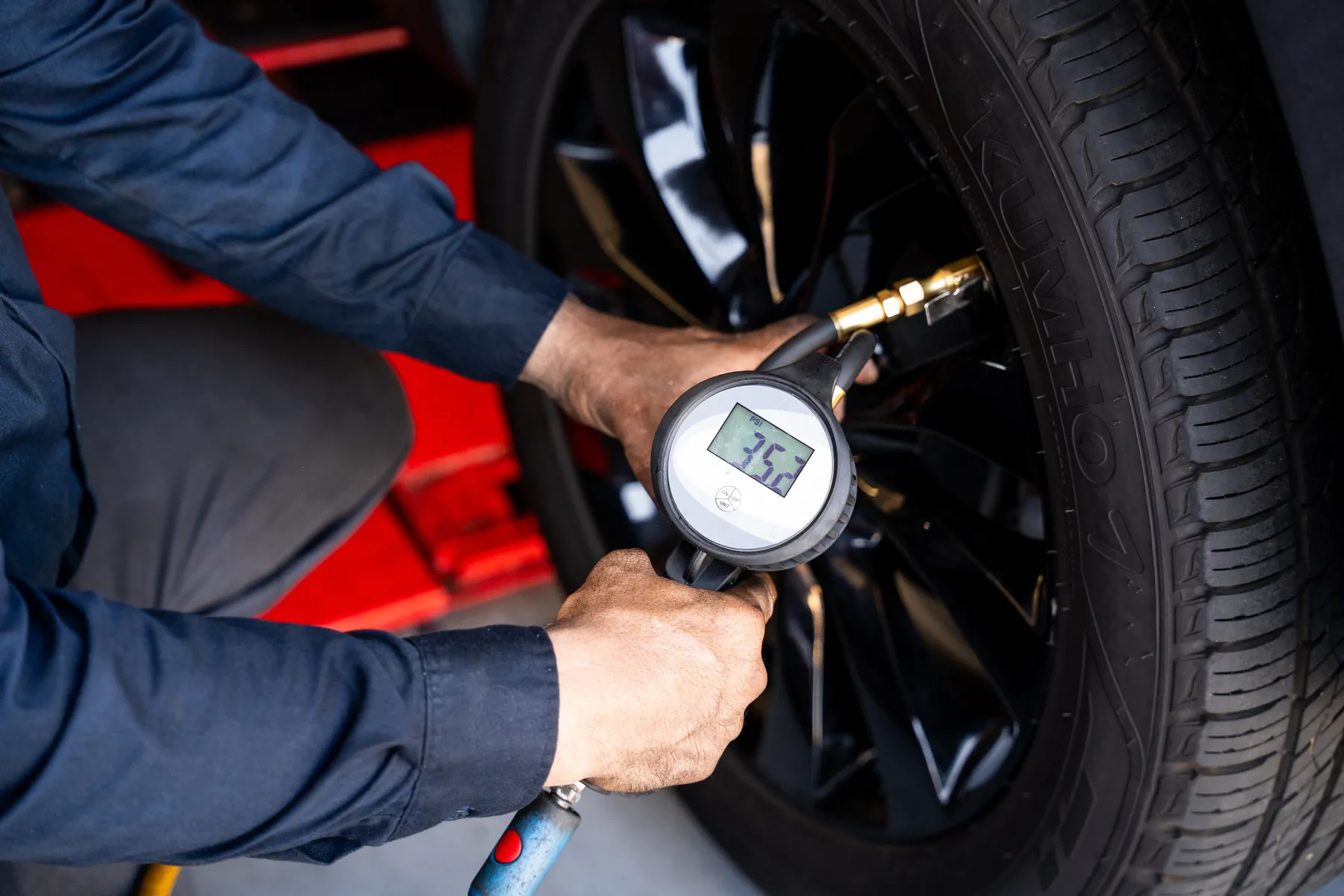
A solid TPMS light means at least one tire has dropped to roughly 25 percent below the cold pressure on your door placard. A light that flashes for about a minute at startup and then stays on means the monitoring system itself has a fault, usually a sensor.
It's the yellow symbol shaped like a tire cross-section with an exclamation point in the middle. Every car, SUV and light pickup built since September 1, 2007 has one. It means one of two very different things, and the way it lights up tells you which.
Solid light: a tire is low
The federal standard for tire pressure monitoring, FMVSS 138, requires the warning to come on when a tire drops to 25 percent below the vehicle maker's recommended cold pressure, or to a minimum floor set for that tire type, whichever is higher. The light has to come on within 20 minutes of the pressure getting there.
Put numbers on that. If your door placard says 35 psi, the light can stay off until a tire is down to about 26 psi. That's a lot of missing air. The tire is flexing more, running hotter and wearing its edges. A solid light isn't an early warning. It's a late one.
Flashing, then solid: the system has a problem
The same standard covers malfunctions. When the system detects a fault, a combined warning light flashes for 60 to 90 seconds after you turn the car on, then stays lit for as long as the fault is there. Some vehicles use a separate malfunction light instead.
Common causes:
- A sensor with a dead battery. The battery is sealed inside the sensor, so the whole sensor gets replaced.
- A sensor damaged during a tire change, a flat or a curb hit.
- A wheel without the sensor the car is looking for, like an aftermarket set or a spare.
- New sensors installed but never taught to the car (the relearn step, below).
Adding air won't fix a flashing light. It takes a scan tool.
Why it comes on during cold mornings
Air pressure follows temperature. Tires lose roughly 1 to 2 psi for every 10 degrees the temperature drops. At the weather station in Pomona, right next door, the average December day runs from the high 30s overnight to the mid 60s in the afternoon. That's close to a 28 degree swing, worth roughly 3 to 5 psi between the morning drive and the afternoon one.
So if your light comes on at 7 a.m. and goes off by lunch, the system is doing its job. It's telling you a tire is sitting right at the edge. Top all four up to the placard number while they're cold and the light should stay off. Tires also lose 1 to 2 psi a month just sitting. One that loses more than that has a leak.
Summer brings the opposite problem. More on that in tire pressure in Inland Empire heat.
What to do when the light comes on
- Don't ignore it. If the car feels normal, slow down and get somewhere safe to look. If it pulls, thumps or feels mushy, pull over.
- Look at all four tires. A tire that's obviously flat needs the spare or a tow, not more driving.
- Check pressures with a gauge. You can't judge a radial tire by eye. The tire industry's own example shows a tire 50 percent low that looks almost normal.
- Fill to the door placard number. Not the number on the sidewall. That's the tire's maximum.
- Drive a few miles. Many systems turn the light off once the sensors report normal pressure.
- If it comes back within days, you have a leak. A nail, a leaking valve, a damaged wheel or a bead that isn't sealing. Book a flat tire repair.
What TPMS doesn't catch
Treat the light as a backup, not your gauge. USTMA lists the limits:
- It may not warn until a tire is as much as 25 percent low.
- Some systems only detect differences between tires. If all four leak down together, the light may stay off.
- Some systems may not warn of a fast pressure loss in a single tire.
Underinflation before the light comes on gets more dangerous at high speed, with heavy loads, over long distances and in high outside temperatures. Check pressures yourself once a month, and before long trips or towing.
Direct and indirect systems
Most vehicles use direct TPMS: a battery-powered sensor inside each wheel, usually built onto the valve stem, reports pressure by radio. Some use indirect TPMS, which watches wheel speed through the antilock brake sensors. A low tire is slightly smaller, so it spins faster. Indirect systems have no sensors to replace, but they often need a reset after you adjust pressures or rotate tires. Your owner's manual tells you which kind you have and how to reset it.
Sensor service, replacement and relearn
Direct sensors have small parts that wear: the valve core, the rubber grommets that seal against the wheel, the nut and the cap. Service kits contain new ones, and industry guidance is to replace them every time the tire comes off the wheel. Once a grommet is torqued it takes the shape of the wheel, and reusing it can cause a slow leak.
When a sensor dies, the replacement has to be programmed for your vehicle and then introduced to the car. That last step is the relearn. Depending on the make, it's done with a scan tool, a sequence of steps in the car, or a short drive. Some vehicles also need a relearn after a rotation so the car knows which sensor sits in which corner.
Two more things that affect sensors:
- Aerosol tire sealants, the cans that inflate and seal, can interfere with or damage TPMS sensors. Tell the shop if you've used one before they open the tire.
- Run-flat tires require a working TPMS, because a run-flat can look normal while it carries the car with little or no air.
Light still on after you've set the pressures? Book TPMS service at our Montclair shop. We scan each sensor, check the tire behind any low reading, service or replace what's failed, and run the relearn so the light stays off. If you want someone to look over all four tires and the spare at the same time, a tire inspection covers pressures too.
Want a second set of eyes? Book TPMS service.
Book online in a minute, or call (909) 321-2191. 5483 Moreno Street, Montclair.
More questions
Can I drive with the TPMS light on?
If it's solid, check and fill your tires as soon as you safely can, because the light means a tire is already well below spec. If it flashes at startup, the car can usually be driven, but you have no low-pressure warning until the system is fixed, so check pressures by hand.
Why is my TPMS light on when my tires look fine?
A tire can be badly underinflated and still look normal. Check all four with a gauge, and if they're right and the light stays on or flashes, a sensor needs attention.
Do I need new TPMS sensors with new tires?
Not automatically. Working sensors can be reused with fresh service-kit parts, but if a sensor is failing or damaged, replacing it while the tire is already off saves a second visit.
Does rotating my tires affect the TPMS?
On some vehicles, yes. The car may need a relearn so it knows each sensor's new position, and indirect systems usually need a reset.
Keep reading
5 MIN / Service explained
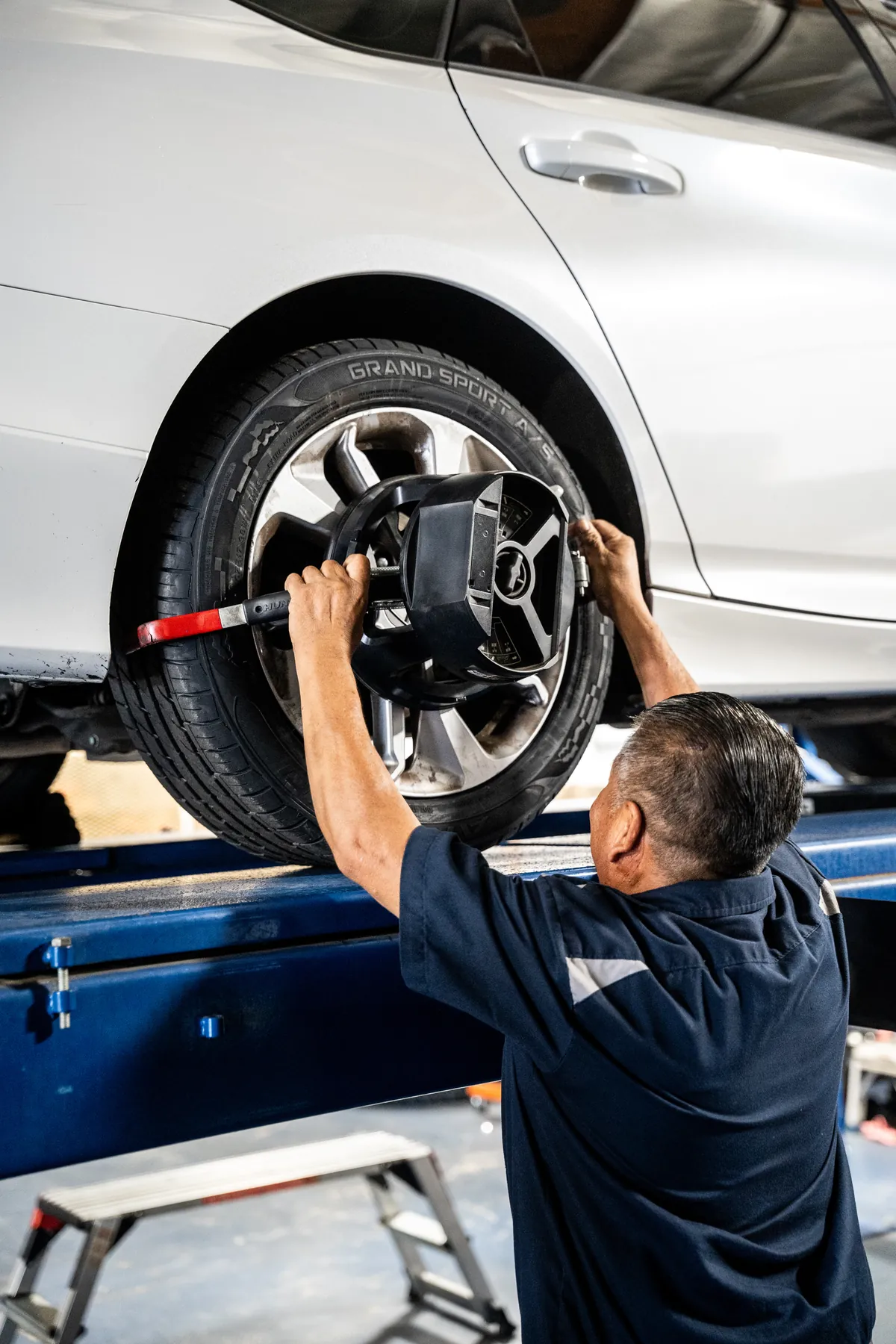
Alignment vs. balancing: what each one fixes
Alignment fixes pulling, a crooked wheel and edge wear. Balancing fixes highway vibration. How to tell which you need, and when road force balancing helps.
5 MIN / Service explained
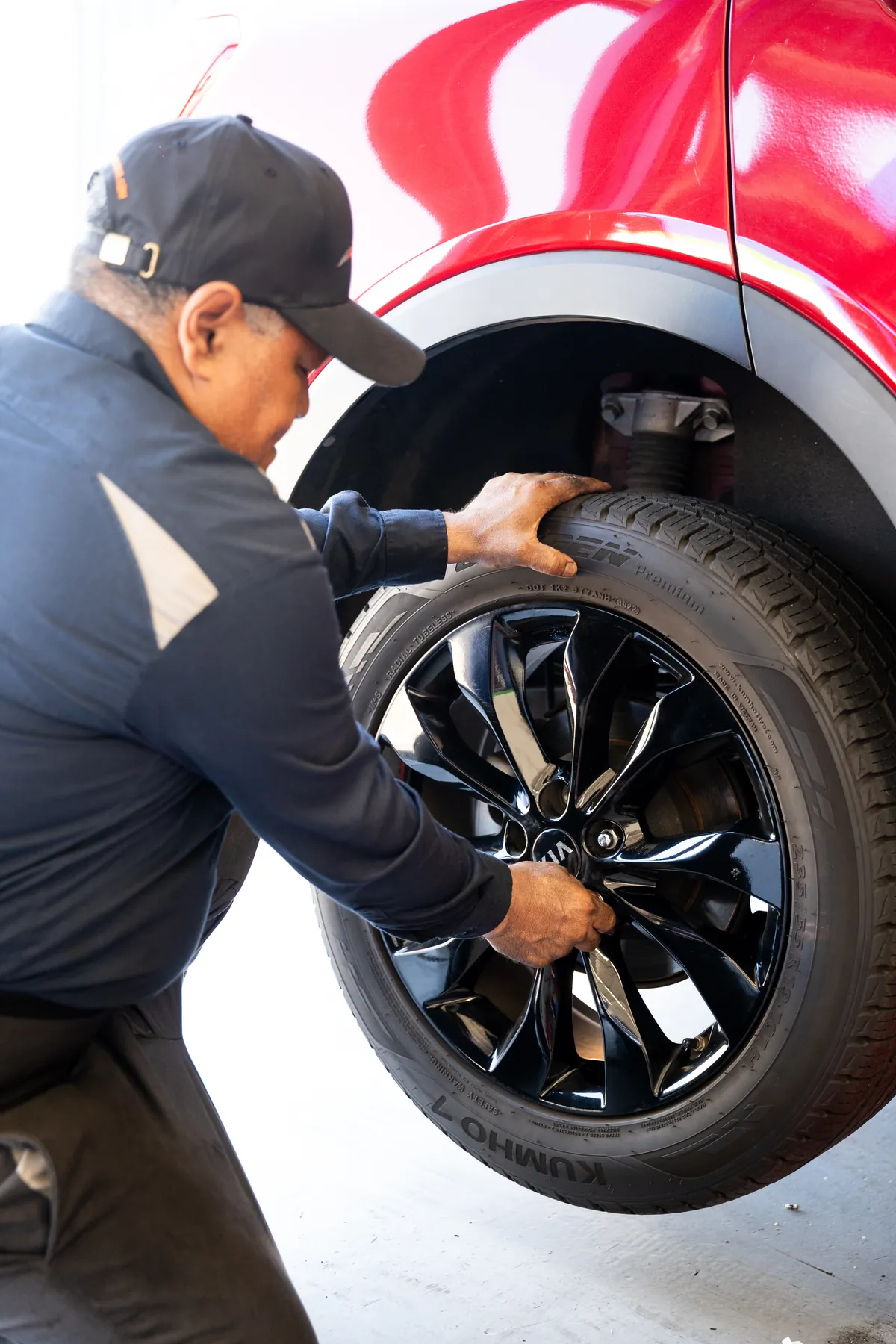
Which flat tires can be repaired
The tire industry's repair rules in plain English: tread area only, 1/4 inch maximum, plug and patch from the inside, and why the sidewall can't be fixed.
6 MIN / Buying tires
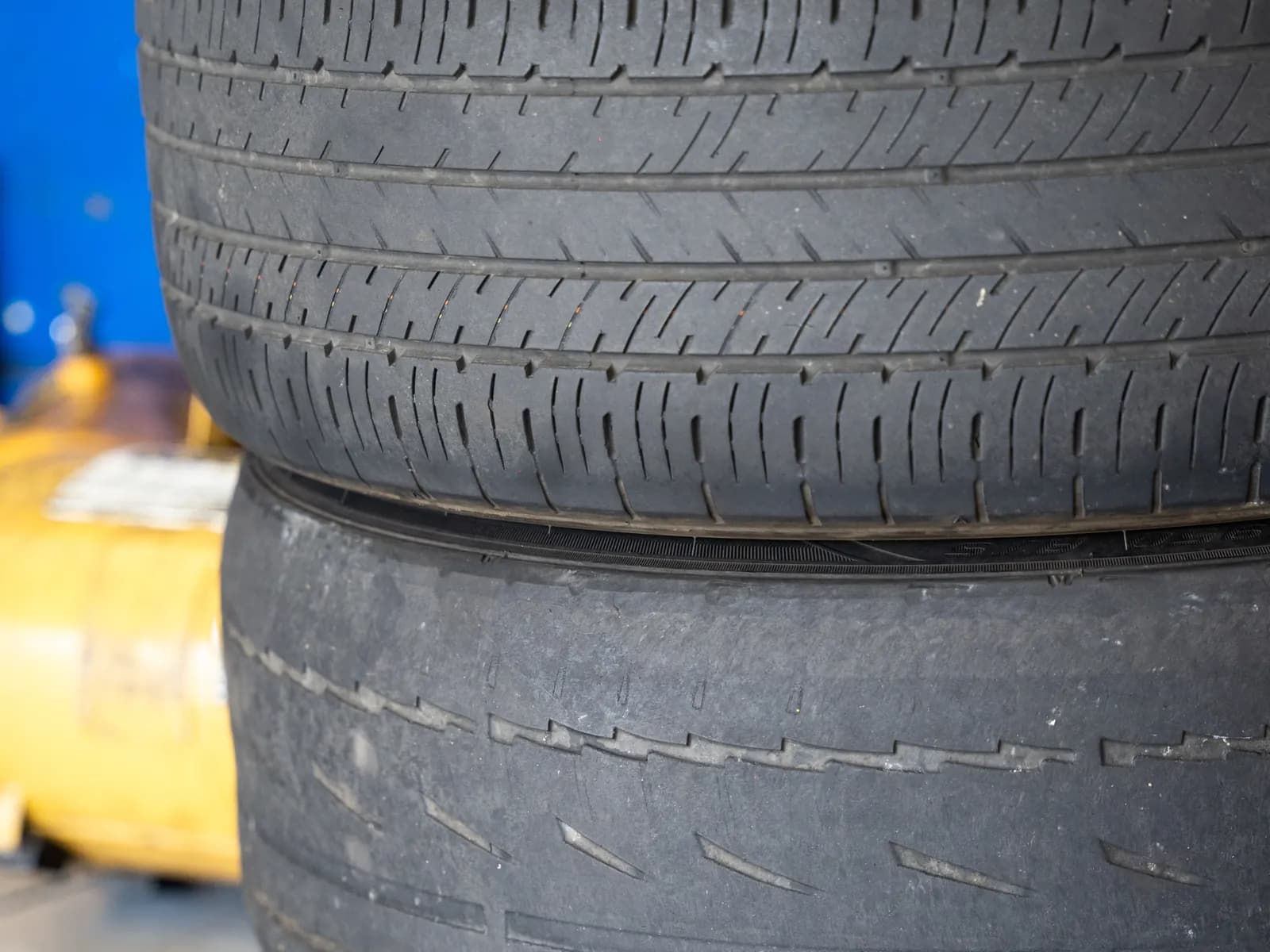
How to read a tire size
What every part of a tire size like 225/65R17 102H means: width, aspect ratio, wheel size, load index, speed rating and the DOT date code.